The Evolution of Academic Assessment: A History of the GPA System
Published on | By Academic Research Team
The Grade Point Average (GPA) is the undisputed currency of the modern academic and professional world. From securing university admissions to passing initial HR screenings, a single numerical value dictates countless opportunities. However, the quantitative grading of human intellect is a relatively recent phenomenon. Our researchers trace the fascinating evolution of academic grading from medieval oral examinations to the standardized 4.0 scale used today.
The Pre-Industrial Era: Oral Defense and Public Humiliation
Prior to the late 18th century, prestigious institutions such as Oxford, Cambridge, Harvard, and Yale did not employ quantitative grades. Academic assessment was entirely qualitative and highly theatrical.
Students were required to participate in public oral examinations, frequently conducted entirely in Latin, where they debated senior faculty members. The assessment was effectively binary: you either demonstrated sufficient mastery of the classical quadrivium, or you were subjected to public humiliation. There was no concept of a "B+" or a "C-"; one simply passed or failed based on subjective faculty consensus.
1792: The Industrialization of Education at Cambridge
The catalyst for quantitative grading was not a desire for educational precision, but rather a need for industrial efficiency. As university enrollments swelled during the Industrial Revolution, the traditional oral examination became logistically unsustainable.
The Farish Innovation: In 1792, a tutor at the University of Cambridge named William Farish proposed an unprecedented solution: assigning numerical values to written student examinations. This innovation allowed a single professor to evaluate dozens of students simultaneously, effectively "mass-producing" academic assessment.
1813: Yale University and the Progenitor of the 4.0 Scale
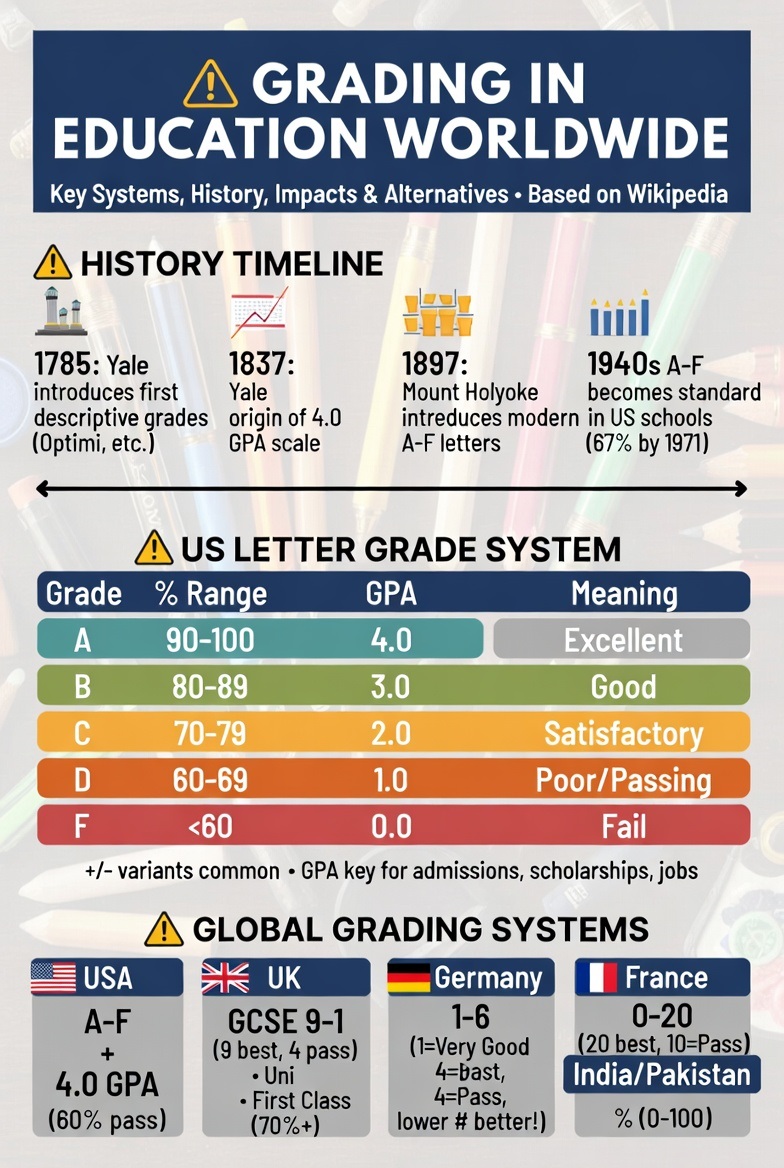
The first recorded instance of a 4-point scale in the United States occurred at Yale University in 1813. However, it was not the decimal-based GPA we recognize today. Yale President Ezra Stiles implemented a rudimentary mathematical ranking system designed to categorize student performance into broad quartiles:
- Optimi (4): The highest tier of scholars.
- Second Optimi (3): The secondary tier.
- Inferiores (2): Below average performance.
- Perjores (1): Unacceptable performance.
1897: Mount Holyoke and the Standardization of Letters
The direct ancestor of the modern American grading system was formalized at Mount Holyoke College in Massachusetts in 1897. Seeking a standardized method to communicate student transcripts to other institutions, faculty implemented the first percentage-to-letter grade conversion matrix:
- A (95-100%)
- B (85-94%)
- C (76-84%)
- D (75%)
- E (Failure)
The Missing 'E': The original system utilized the letter 'E' to denote a failing grade. However, within a decade, academic administrators noted a psychological vulnerability in the system: parents and students occasionally misinterpreted 'E' as standing for "Excellent." To eliminate this critical ambiguity, institutions universally adopted the letter 'F' to explicitly denote "Failure," creating the A, B, C, D, F scale utilized today.
The Modern Era and the Future of Assessment
In the mid-20th century, the letter grade system was mathematically fused with a decimal-based point system, allowing for the calculation of a cumulative average. This created the modern GPA formula you can calculate on our homepage tool.
While contemporary academic movements (such as "Un-grading" and competency-based education) advocate for a return to qualitative feedback, the 4.0 GPA scale remains deeply entrenched. It serves as the foundational algorithmic filter for corporate recruitment, scholarship allocation, and graduate school admissions globally.